Nevada is the most surprising fly fishing state in the West, because almost all of it happens in two places that could not be more different. In the northwest, Pyramid Lake holds the largest cutthroat trout in the world, Lahontan cutthroat of the Pilot Peak strain, fished from ladders in a desert lake on tribal land under tribal rules. An hour away, the Truckee River runs out of Lake Tahoe and straight through downtown Reno, a freestone river of wild browns and rainbows fished within sight of the city. Behind those two, Nevada holds the East Fork Carson, the South Fork Humboldt, and the put-and-take reservoirs of the high desert, all fished under state rules. The first thing to understand about Nevada is that the two regimes are separate. Pyramid Lake is managed by the Pyramid Lake Paiute Tribe, and a Nevada fishing license does not apply there; a tribal permit does. Everywhere else in this guide, Nevada Department of Wildlife rules apply. Keep the two straight, and Nevada opens up.
This guide covers Pyramid Lake in full, because the previous version of this page mentioned it only in passing, and the lake is the reason most fly anglers come to Nevada. It refreshes the Truckee River with current regulations, confirms the East Fork Carson and South Fork Humboldt against current NDOW sources, and keeps Eagle Valley Reservoir as the high-desert stillwater option. One water from the previous version is deliberately removed: the Little Truckee River, which is a California tailwater between Stampede and Boca reservoirs, fished under California regulations with a California license. It is mentioned once, clearly labeled as California water, in the trip planning section, and nowhere else as a Nevada fishery.
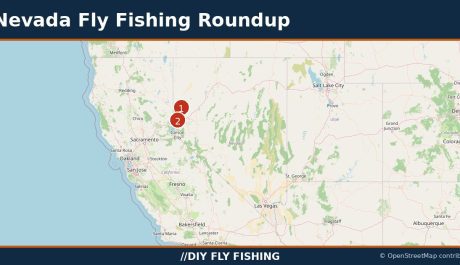
Nevada Fishing Map

Get Directions to the Fishing Access Points shown above with the DIY Fly Fishing Map
Best Places to Fly Fish in Nevada
Pyramid Lake
Pyramid Lake lies entirely within the Pyramid Lake Paiute Reservation, about 35 miles northeast of Reno, reached by Nevada Route 445, Pyramid Way, about 33 miles northeast to Sutcliffe, roughly 45 minutes to an hour from central Reno. The reservation includes Nixon, the tribal headquarters at the lake’s south end, and Sutcliffe on the west shore. The lake covers 125,000 acres, one of the largest natural lakes in Nevada and the biggest remnant of ancient Lake Lahontan. It is fed by the Truckee River, its only inflow, and it has no outlet. The lake is sacred to the Paiute people, and the tribe asks visitors to be respectful of the lake and land, which are considered sacred and home to threatened and endangered species, and to leave no trace. Most shore fishing is on the west shore, off Highway 445 through Sutcliffe. The following areas are closed to the public: the Needles area, Anaho Island, the Marble Bluff area, the Beehives, and the Pyramid and Stone Mother. Check the tribe’s map and regulations brochure for the closed areas before you go. As of October 2026, Popcorn Beach boat launches are closed by Tribal Council order, at the request of the Aquatic Invasive Species Program, because of the golden mussel outbreak in California and potential impacts near the delta of the Truckee River.
The fish are Lahontan cutthroat trout of the Pilot Peak strain, and the story behind them is one of the great recovery stories in American fisheries. A small population in the Pilot Peak Mountains carried the exact genetics of the original giant Pyramid Lake fish, matched by genetics to museum mounts from 1872 to 1911, and the Pilot Peak strain forms the backbone of Lahontan cutthroat recovery efforts. Stocking of Pilot Peak fish into Pyramid Lake began in 2006 in collaboration with the Pyramid Lake Paiute Tribe, and the U.S. Fish and Wildlife Service hatchery now produces approximately 500,000 Pilot Peak strain fish annually for release into Pyramid Lake, the Truckee River, and the Lake Tahoe Basin. The Fish and Wildlife Service calls the Lahontan cutthroat the largest cutthroat trout in the world, capable of reaching enormous sizes in the ancient lakes of the Great Basin, and describes the Pilot Peak strain as uniquely adapted to growing large in lake environments, over 25 pounds. This guide uses only that authoritative size language. Larger historical and record claims circulate in magazine writing, and no average-size figure is quoted here, because none was verified on an authoritative source. The honest current-season evidence is from this site’s own October 2026 roundup, which reported Lahontan cutthroats over 20 pounds in the first five days of the October opener. Pyramid Lake is also the only habitat in the world for the cui-ui, listed as endangered in 1967. Cui-ui cannot be targeted while fishing, under tribal custom and their special status, and any cui-ui caught must be released; the tribe’s September 2026 proposed changes would write that release requirement into the regulations, but whether the proposal was adopted was not established at research time.
The season runs October 1 through June 30, verified on the tribe’s permits page and confirmed by the tribe’s own regulation-change document quoting the current brochure language. The trout season is closed July 1 through September 30. A September 2026 tribal proposal would close all fishing in summer and remove an old provision that had allowed shore-only fishing for non-trout, non-cui-ui species in summer; that proposal’s adoption status is unverified, so this guide states only the October 1 through June 30 trout season and directs readers to the current tribal brochure for summer rules. A tribal permit is required instead of a Nevada state license at Pyramid Lake. Buy permits before visiting: online at PyramidLake.us, at the Ranger Station at 2500 Lakeview Drive, Sutcliffe, open every day from 6:00 a.m. to 6:00 p.m., or at the Pyramid Lake Museum and Visitor Center at 709 State Street, Nixon, open Monday to Friday, 10:00 a.m. to 4:30 p.m. The verified fee schedule on the tribe’s own permits page, retrieved October 30, 2026, and confirmed unchanged in the tribe’s September 2026 proposed-changes document, is: daily fishing $27.00, three-day fishing $70.00, second rod daily $27.00, second rod three-day $70.00, youth ages 12 to 17 daily $15.00 and three-day $39.00, and no seasonal permits. Vendors may charge an additional administrative fee up to $1.00. Older secondary figures of $24 and $62 are outdated and are not used here. Related tribal permits on the same schedule include day use $25.00, daily boating $30.00, and overnight camping $35.00 per vehicle per night. Whether a fishing permit alone covers lake access or a separate day-use permit must also be purchased is ambiguous on the tribal sources retrieved; confirm at purchase whether a separate day-use permit applies to your visit. The tribe no longer accepts American Express. The tribe publishes a list of approved fishing guides and boat charters for 2026-27; only guides and charters approved by the Tribal Council may operate on the lake, so hire from that list.
Harvest and tackle rules at Pyramid Lake are set by the tribe’s current regulations brochure, and they are strict. This guide deliberately publishes no slot-limit or bag-limit numbers for Pyramid Lake, because the numbers consistently reported in secondary and guide sources, a 17-to-20-inch slot with fish over 24 inches, were not verified on any tribal source retrieved, as the tribe’s full October 2025 regulations brochure was not directly retrievable in research. The same applies to the commonly reported barbless-hooks-only and no-bait rules and to any do-not-fillet rule: they are unanimous in secondary sources but were not verified on a tribal source retrieved. Do not rely on a guidebook number. Read the current tribal brochure, available through the tribe’s permits page, before you fish, and fish under the brochure’s rules as written. What the tribal sources do verify is the framework: tribal permit, October 1 through June 30 season, closed areas, and tribal enforcement through the Pyramid Lake Rangers. That framework, plus the brochure, is the complete rule set for the lake.
Truckee River
The Truckee River originates at the outlet of Lake Tahoe and flows approximately 110 miles to Pyramid Lake, and the Nevada Department of Wildlife manages approximately 40 miles of fisheries between the California state line and the Pyramid Lake Indian Reservation. It is one of the most heavily fished waters in the state, supporting between 60,000 and 100,000 angler days per year. Anglers can fish for rainbow trout, brown trout, cutthroat trout, mountain whitefish, and largemouth bass in the lower sections. High runoff from March to June makes fishing difficult, but once flows return to normal in summer the river becomes easier to fish, and some of the best fishing occurs in late spring and early summer. The river is a freestone of wild brown and rainbow trout, with the U.S. Fish and Wildlife Service periodically stocking Lahontan cutthroat around the major parks, so the accurate framing is wild browns and rainbows plus stocked and recovering Lahontan cutthroat, not wild-only or stocked-only. The river flows directly through downtown Reno, which is a defining feature: dozens of public parks and trails line an urban trout river. The previous version of this guide claimed the river receives stock of around 50,000 ten-inch sterile rainbows; that figure does not match NDOW’s 2026 stocking table, which shows repeated roughly 5,000-fish cutthroat stockings in April and May 2026, and the old stocking sentence is dropped entirely rather than replaced with a new number.
Access runs from the canyon reach at the state line through the city and east toward the reservation. Mayberry Park, Mogul, Farad, and Floriston are named by Visit Reno Tahoe as some of the most popular and accessible spots for wild brown and rainbow trout. Farad sits just inside California at the Farad gauge and Interstate 80 corridor, so present Farad and Floriston as the canyon reach near the state line, fished with a Nevada license on the Nevada side and a California license on the California side. Crystal Peak Park in Verdi is a verified access point west of Reno toward the California line, and the stretch from Mayberry Park to Wingfield Park through downtown Reno is a recognized wade and float reach through public parks, fishing surprisingly well through the city with brown and rainbow trout and a few mountain whitefish. The lower river east through Sparks toward Lockwood and Mustang holds larger fish and streamer water. The previous guide’s West 4th Street access wording was not verified in any 2026 source and is replaced here with the downtown Reno parks and Riverwalk framing. In fall 2026, cooling water pushed fish into slower water adjacent to feeding lanes, with blue-winged olive and midge hatches dominating, nymphing the primary technique, and streamer fishing picking up as brown trout entered pre-spawn behavior in late October. No flow figure is quoted as current in this guide; check the Farad and Reno gauges before you go, as this dam- and snowmelt-influenced river changes quickly.
The Truckee’s special regulations, from the Western Region regulations applicable to CR 25-16, are: year-round, any hour of the day or night, except that the portion from Derby Dam downstream 1,000 feet is closed to fishing; the limit is three game fish generally, except that in the section from the East Mustang Road bridge, Interstate 80 Exit 23, downstream to Derby Dam, and from 1,000 feet downstream of Derby Dam to the Pyramid Lake Paiute Reservation boundary, the limit is three game fish of which only one may be trout, and only artificial lures with single barbless hooks may be used. The previous guide’s three-game-fish statement was broadly correct but incomplete, omitting the downstream one-trout restriction, the single-barbless-hook rule, and the Derby Dam closure, and all three are added here. Two claimed special sections were not verified and are omitted: a secondary summary’s upstream section above Interstate 80 with a 14-inch minimum and two-trout limit does not appear in the Western Region regulations retrieved, and a tourism claim of a fly-fishing-only, catch-and-release section close to downtown Reno has no counterpart in the NDOW regulations retrieved. Neither is presented as a Nevada regulation.
East Fork Carson River
The East Fork Carson River fishery in Nevada runs 21 miles to its confluence with the West Fork near Genoa, a river 30 to 60 feet wide whose spring flows over 1,000 cubic feet per second usually make wading impossible until summer, when flow drops between 50 and 150 cubic feet per second. It is a put-and-take fishery, and fishing is generally best at the trout stocking sites: Ruhenstroth Dam, also called Broken Dam, upstream of Gardnerville, and Centerville Bridge, also called Lutheran Bridge, in Gardnerville. NDOW’s 2026 stocking confirms the put-and-take character is current, with 765 rainbow trout stocked October 20, 2026, 1,505 on October 12, and 773 on October 6, plus 1,001 brown trout on June 15. A NDOW report from September 4, 2026, describes the river flowing at normal fall levels, with light lines, leaders, and tippets and small flies and lures the best bet. The State of Nevada owns the entire river channel, which is open to the public, but the river meanders through private and Washoe Tribal lands in Carson Valley, so be aware not to trespass on private property to access the river. Do not import California-side East Fork regulations into the Nevada section: the two-fish, 14-inch-minimum and Hangman’s Bridge trophy-section rules are California rules for the reach above the state line, and no East Fork Carson special regulation appears in the NDOW Western Region regulations retrieved, so the general Western limit of five trout applies. The California East Carson River guide covers the upper river.
South Fork Humboldt River
The South Fork Humboldt River, near Elko in northeastern Nevada, is divided by South Fork Dam, completed in 1988. Upstream from the dam, the river runs seven miles to State Route 228, and below the dam it is fishable for approximately 12 miles to Hunter Banks Diversion Dam. Game fish include Bowcutt trout, a rainbow and cutthroat hybrid, rainbow trout, brown trout, smallmouth bass, and channel catfish, originally from the reservoir, with fish from 14 to 22 inches. The best times are March through June and September through December. The limits must be stated with the causeway wording, not the reservoir wording. The 2026 Eastern Region special regulations give: the South Fork of the Humboldt River from the Lucky Nugget Subdivision causeway upstream to Lee, year-round, one trout, only artificial lures with single barbless hooks; and South Fork Reservoir and the South Fork from the Lucky Nugget causeway downstream to its confluence with the Humboldt River, five trout, one black bass, one white bass hybrid, and five channel catfish, with a 15-inch minimum for black bass and wipers and black bass catch and release only March 1 through June 30. NDOW’s December 2025 fishing report repeats the upstream rule and notes low fall flows with the best fishing in deeper pools. Access is through South Fork State Recreation Area off Route 228 and from the Lucky Nugget Subdivision causeway; Bullion Road access wording from the previous guide was not re-verified and is not repeated here.
Eagle Valley Reservoir
Eagle Valley Reservoir, in Spring Valley State Park near Pioche in Lincoln County, is the high-desert stillwater option: a put-and-take fishery stocked with rainbow trout, brown trout, and tiger trout, a brown and brook hybrid, with an accessible fishing pier and boat ramp listed by NDOW. The best fishing is April through June and September through October, with ice fishing in cold winters, and the hub’s general framing of good fishing year-round holds. Specific stocking volumes and campground numbers from the previous guide, including a 40,000-plus stocking figure and counts of campsites, bathrooms, and showers, were not verified in any current source and are omitted; the park has campgrounds and day-use amenities, and readers should check Nevada State Parks for current details. No Eagle Valley special regulation was retrieved, so no water-specific limit is stated beyond the general limit.
Ladder Fishing at Pyramid Lake
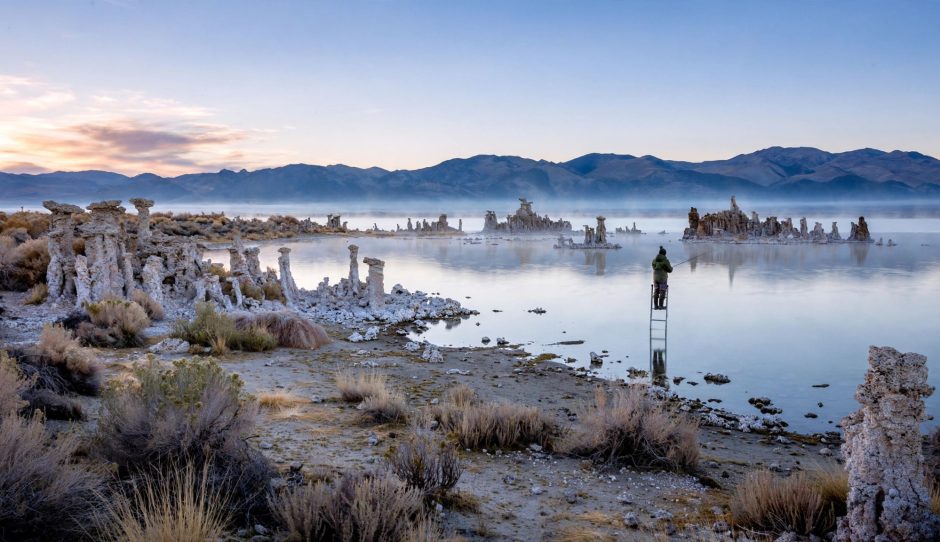
Ladder fishing is the signature technique of Pyramid Lake, and it exists because of the lake’s shape. Anglers wade out and stand or sit on a ladder, often a step ladder with a seat or platform, placed in the lake, which gets them out of the cold water, elevates them for longer casts, and puts their flies over the drop-off and shelf where cruising cutthroat travel. At shallow beaches the drop-off can be more than 200 feet offshore, where ladders are a must to extend casts out to the target area. Anglers wade out to waist or armpit depth and climb onto the ladder to cast. Many fly shops rent ladders, a stripping basket is described as a must for streamer fishing, and warm clothing and waders are essential. Locally crafted ladders with padded seats and platforms are favored by seasoned anglers. The famous shore spots, all verified in multiple sources, are Pelican Point, Warrior Point, and Spider Point on the northwest side, the Nets, North and South Nets, the classic ladder-fishing beach just south of Sutcliffe, and Windless Bay and Monument Rocks. Shore access is concentrated on the west side, and the tribe’s closed areas and the Popcorn Beach boat-launch closure, stated above, must be respected.
Three core fly techniques cover the lake, consistently described across independent guide and shop sources. First, indicator or suspension nymphing with balanced leeches and chironomids, often a two-fly rig with flies at different depths, with indicator depth commonly five to nine feet depending on conditions. Second, stripping streamers and baitfish patterns on sink-tip or full-sinking lines, cast as far as possible and stripped slowly back along the sandy bottom where trout cruise looking for food. Third, the deep-water dangle, a jigging-style technique, early in the season. Lahontan cutthroat feed heavily on tui chub bait balls, and stripping streamers along drop-offs as cutthroat chase tui chub is the fall play. As water cools, fish move: in October, fishing is mainly in deeper water, anywhere from 15 to 80 feet deep, primarily with the dangle technique, and in November anglers embrace shallower water with indicator rigs and stripping setups as shore anglers arrive. Shore fish move into shallow water, five to 15 feet, starting in late February for spawning, making March and April the best shore months. Present that as a general pattern, not a guarantee. Wind helps the fishing: fish are more wary under a mirrored surface, and wind ripples the lake and provides cover for cruising fish, with chop, mudlines, and foam lines concentrating feeding fish. But Pyramid Lake wind is famous and hazardous for small craft, and it can rise fast off the desert; check the forecast, watch the north end, and get off the water early if it builds. The National Weather Service issued a Lake Wind Advisory for Pyramid Lake on August 31, 2026, with southwest winds 15 to 25 miles per hour gusting to 35 and wave heights up to three feet, hazardous for small craft. Do not quote a typical wind speed; check the forecast every day you fish.
Best Time to Fly Fish in Nevada
Pyramid Lake sets the Nevada calendar. The season runs October 1 through June 30, with the strongest fly-fishing months October through April: fall staging in October and November, when the opener produced trophies over 20 pounds in the first five days of the 2026 season and November is called the heart of angling excitement as shore anglers arrive and fish feed on tui chub, then the shallow-water shore bite in late winter and spring, March and April, as fish move into five to 15 feet of water for spawning. Boat anglers can find fish all season. The Truckee fishes year-round, with high runoff March through June making fishing difficult, the best fishing in late spring and early summer once flows normalize, and a strong fall of cooling water, blue-winged olive and midge hatches, deep nymphing near the bottom, and streamers for pre-spawn browns. The East Fork Carson fishes best at its stocking sites through the stocked season, with normal fall levels and small flies the call in September and October. The South Fork Humboldt is best March through June and September through December. Eagle Valley Reservoir is best April through June and September through October, with ice fishing in cold winters. Summer in Nevada is the Truckee’s early-morning game and the high-desert reservoirs; winter is Pyramid Lake’s season, and the lake is closed July 1 through September 30.
Essential Fishing Gear
At Pyramid Lake, the rods are 7- and 8-weights, plus 11-foot 7-weight switch rods for indicator rigs: cast sink-tip or full-sinking lines on sturdy 7- or 8-weight rods, with an indicator setup of a 9-foot 8-weight or an 11-foot 7-weight switch rod and a stripping setup of a 9-foot 8-weight with a full-sinking line. Do not claim a 6-weight is standard at Pyramid on the evidence retrieved; the attested range is 7- and 8-weights. Bring a ladder, rented or owned, a stripping basket, warm clothing, and waders, and expect to wade to waist or armpit depth to reach the ladder. On the Truckee, a 9-foot 5-weight is the general trout setup, consistent with guide reports, with heavier 6-weights commonly used for streamer and deep-nymphing work; present 5- to 6-weight as a general range, not a rule, with 4X to 5X tippet for dries and blue-winged olives, heavier 3X to 4X for nymphing, and 0X to 1X for streamers in the lower river. Tight-line and Euro nymphing shine in the faster pocket water, with weight to get the flies within six inches of the bottom in runs three to five feet deep in cold water. For the East Fork Carson, light lines, leaders, and tippets with small flies and lures are the NDOW-reported call. Carry sun protection and water everywhere in Nevada, and download offline maps before driving to Pyramid Lake, where services are limited to the tribal Museum and Visitor Center, the Ranger Station and marina area, and a store, with Reno and Sparks the nearest full services.
Best Flies for Fly Fishing in Nevada
The Pyramid Lake box starts with balanced leeches and chironomids, midge pupae in red, black, silver, and blue, leech and streamer patterns, tui-chub baitfish imitations, Woolly Buggers including the Midnight Cowboy, Popcorn Beetles and Pyramid beetles with a white foam back and chartreuse body, a local Pyramid pattern, and minnow patterns. For stripping, carry baitfish in olive and white, Woolly Buggers, Deceivers, Clousers, and articulated streamers. The Truckee box, from 2026 reports, is: nymphs, Baetis and blue-winged olive nymphs in sizes 16 to 22, zebra midges in 18 to 24, pheasant tails and jig pheasant tails, Perdigons, stonefly nymphs including Jimmy Legs and little brown stones in 12 to 14, caddis and pale morning dun nymphs, and golden stones in summer; dries, blue-winged olive emergers and dries in 20 to 22 in the midday hatch window, Parachute Adams, Griffiths Gnat and midge clusters, and October caddis stimulators in fall; streamers, small dead-drifted streamers near the bottom and larger patterns, Dolly Llama, Sculpzilla, and Zoo Cougar types, for pre-spawn browns in late fall. On the East Fork Carson and the South Fork Humboldt, carry small nymphs and dries matched to the hatch, with streamers for the Humboldt’s larger browns and Bowcutt trout. At Eagle Valley Reservoir, carry the stillwater box: Woolly Buggers, leeches, chironomids, and damsel patterns fished on sinking lines.
Nevada Fishing Regulations
Nevada’s state regulations and the Pyramid Lake tribal regulations are separate systems, and this section keeps them separate. For state waters, anyone 12 years of age or older must have a fishing license in their possession while in the field in Nevada; children under 12 do not need a license. The verified fees on NDOW’s official fee schedule, retrieved October 30, 2026, prices not including a nominal processing fee, are: resident annual adult fishing license, 18 and older, $40.00; resident annual adult hunt and fish combination, $75.00; resident annual youth hunt and fish combination, ages 12 to 17, $15.00; resident one-day fishing permit, 18 and older, $9.00, with each consecutive day $3.00; nonresident annual adult fishing license, 18 and older, $80.00; nonresident annual youth hunt and fish combination, ages 12 to 17, $15.00; nonresident annual Nevada Interstate Boundary Waters license, $30.00; nonresident one-day fishing permit, $18.00, with each consecutive day $7.00; resident specialty combinations for seniors 65 and older, servicemen, severely disabled, and disabled veterans, $15.00; and Native American specialty combination, $10.00. The previous guide’s fees, youth $13, adult $29, senior $13, nonresident youth $21 and adult $69, with age bands of 12 to 15 and 16 and older, are stale and are replaced here; NDOW now prices adults at 18 and older and youth combinations at 12 to 17. Licenses can be purchased online any time of year. Nevada’s fishing license covers trout: no separate trout stamp is listed on NDOW’s current fee schedule, and no trout-stamp or second-rod price is quoted here. Secondary sources conflict, with several stating a $10 resident and $15 nonresident trout stamp is required, but NDOW’s own fee schedule lists no stamp, consistent with a 2018 license simplification that folded roughly 40 separate license options, including trout and second-rod stamps, into four license classes. The previous guide’s sentence requiring a $10 trout stamp is deleted. Confirm at purchase if anything about endorsements has changed.
General seasons and limits for state waters: the Western and Eastern regions are generally open year-round, any hour of the day or night, except on special-regulation waters. The Western Region general daily limit, where no special regulation applies, is five trout, five mountain whitefish, and 15 warmwater game fish, with a maximum of five black bass and five walleye; the Eastern Region general daily limit is five trout, five mountain whitefish, and 15 warmwater game fish, with a maximum of ten black bass. Possession limit is two times the daily limit for the water fished. The Truckee special regulation is stated in full in the Truckee section above, and the South Fork Humboldt special regulation is stated in full in that section above. At Pyramid Lake, none of the state figures in this paragraph apply. The tribal permit, the October 1 through June 30 season, the closed areas, and the tribe’s regulations brochure govern, and the brochure’s harvest and tackle rules must be read before fishing. NDOW’s own Western Region page states it plainly: Pyramid Lake is managed by the Pyramid Lake Paiute Tribe, and anglers should contact the tribe for regulations and license requirements pertaining to Pyramid Lake. The tribe’s permits page is at PyramidLake.us/permits. Regulations change, and this guide is a summary: check the current NDOW regulations and the current tribal brochure before you fish.
Trip Planning Tips
Base in Reno and Sparks. Reno is the natural base for both Pyramid Lake, about 35 miles northeast and 45 to 60 minutes via Nevada Route 445, and the Truckee, which runs through the city itself, with the nearest full services and fly shops. Stock up in Reno or Sparks before driving to the lake, where services are limited, and buy your tribal permit before visiting, online or at the Ranger Station or Museum, confirming at purchase whether a separate day-use permit applies. Lakeside lodging and dining are limited and have been in flux, with conflicting reports about the lakeside lodge’s status through 2026, so verify current status before relying on them; most anglers base in Reno and Sparks. Hire only Tribal Council-approved guides at Pyramid Lake, from the tribe’s published 2026-27 list. On the Truckee, remember the state-line qualifier at Farad and Floriston, and the Derby Dam closure and downstream one-trout rule. On the East Fork Carson, respect private and Washoe Tribal land when accessing the river. The Little Truckee River is a day trip across the line, not a Nevada water: it is a four-and-a-half-mile tailwater flowing out of Stampede Reservoir into Boca Reservoir in California, a short drive from Truckee, California, prized for technical fishing and wild trout, fished under California regulations with a California license, and covered in the Little Truckee River California guide and the Truckee River California guide for the California reach. Finally, respect the land you are on: Pyramid Lake is tribal land, sacred to the Paiute people, and home to threatened and endangered species. Leave no trace, obey speed limits, respect closed areas, and be courteous to tribal members.
Why Nevada Rewards the Curious Angler
Nevada rewards anglers who look past the obvious. The obvious Nevada is desert and neon, and the fishing Nevada is a desert lake full of the largest cutthroat trout in the world, fished from a ladder in the wind, and a freestone river running through a city, fished on a lunch break. Behind those two are the quiet waters: a put-and-take fork of the Carson, a trophy section of the Humboldt above a causeway, and a high-desert reservoir full of tiger trout. The state asks for two kinds of preparation: a tribal permit and a tribal brochure at Pyramid Lake, and a state license and the special-regulation pages everywhere else. Get those right, check the gauges and the forecast, and Nevada gives back fishing unlike anywhere else in the West. Check our DIY Guide to the Best Fly Fishing Destinations in the U.S. for more waters to explore.