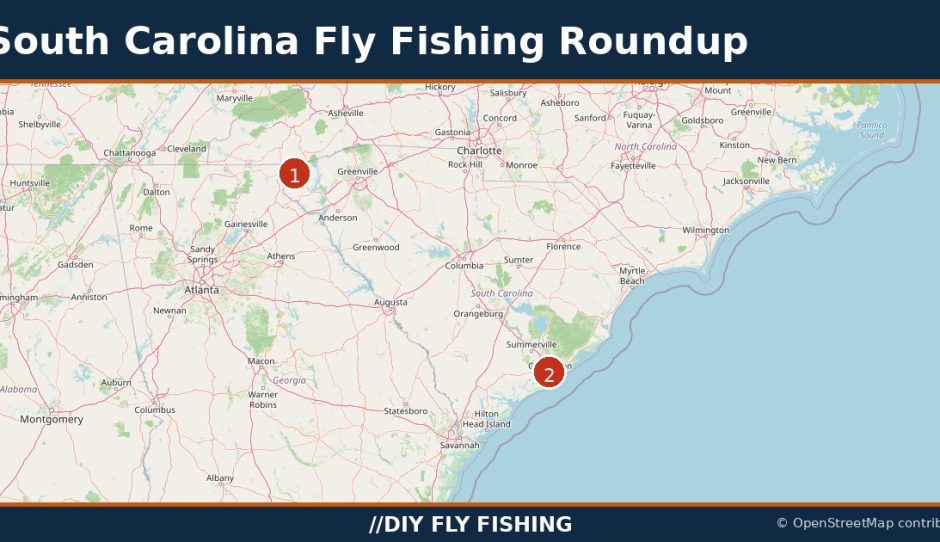
South Carolina fishes both of its fisheries this week. In the mountains, the Chattooga‘s Delayed Harvest reach is open. On the coast, November is doing what November does in the Lowcountry: the redfish are grouping up, the speckled trout are turning on, and the flood tides still belong to the tailers.
Neither fishery needs exaggeration this month. Both are in their prime windows at the same time, which does not happen often.
Plan It With the DIY Fly Fishing App
Heading out on these waters? Plan it with the free DIY Fly Fishing app — maps and turn-by-turn directions to the access points for the South Carolina waters in this report:


Mountains — Chattooga Delayed Harvest
The Chattooga’s DH reach — Georgia Highway 28 upstream to Reed Creek, on the Georgia line — opened November 1 and fishes catch-and-release, single-hook artificials only, through May 14. It is border water, fishable on either state’s license.
This is South Carolina’s most visited fly corridor, and it fishes best on weekdays and early mornings. No fresh stocking date or flow report specific to the reach was found this week — the Georgia program stocks it monthly through the season with state and federal partners.
Other South Carolina DH water includes Eastatoe Creek, Howard Creek, Corbin Creek, and Matthews Creek, plus Cheohee Creek on its Monday-Wednesday-Saturday schedule. Verify boundaries in the SCDNR Trout Book before you go.
Lowcountry — redfish grouping up
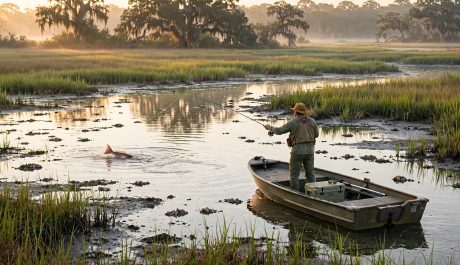
The November shift is under way. A November 5 report from the Beaufort and St. Helena water has redfish biting better and better and starting to group up on low and moving tides, after October’s very high tides kept the tailing game going.
Speckled trout are accelerating as temperatures drop, working creek mouths and current rips on moving water. Charleston-area listings on November 11 rate both redfish and speckled trout as a hot bite, with falling tides over the harbor’s oyster bars the pattern — fish the down-current edges and the grass-line ambush points at creek mouths.
Translate the forage to flies: shrimp and mullet patterns for the grouping reds and creek-mouth trout, crab patterns for the fish still tailing in the grass.
Lowcountry — the flood tides
The signature fishery still applies on the right tides. When the flood tide tops about 5.8 feet in Charleston Harbor, redfish push into the short spartina to feed on fiddler crabs, tails out of the water.
Arrive about an hour before high tide — by the peak, the best of it may already be passing. An 8- or 9-weight, a weedless crab pattern placed ahead of the fish, and the tide chart are the whole program.
One regulation note: redfish limits in South Carolina have changed recently, and the sources available this week disagree on the current slot and bag. Check the current SCDNR rules before you keep a fish — do not rely on last year’s numbers.
Midlands — the Lower Saluda tailwater
The mountains aren’t the whole state. The Lower Saluda runs ten cold miles below Lake Murray dam — South Carolina’s most reliable trout water — and SCDNR’s fall program stocks sub-adult browns each autumn, with catchable rainbows following through the cold months.
Access is easy at Hope Ferry Landing, Saluda Shoals Park and the Gardendale carry-in, but respect the dam: five generators can raise the river fast, so check the release schedule before you wade. Midges and Blue-Winged Olives are the cold-month hatches. The stretch from the I-20 bridge down to Stacey’s Ledge is catch-and-release year-round.
Plan It With the DIY Fly Fishing App
The app gives you access to the South Carolina fisheries mentioned in this roundup and their access points, with hatch reports and stream conditions for them — all of that information is in the app. It covers over 250,000 rivers and lakes and over 100,000 access points nationwide, from the Chattooga to the Charleston flats.